
The transition from a world of low economic growth with high mortality and high fertility to one with low mortality and fertility but sustained growth has been the subject of intensive research in recent years. Over this whole transition, there is a very strong correlation between adult longevity and income. The relation between these two variables is also very strong in a cross section of countries today. This strong relationship is obviously very important to understand the processes that led the various countries through the transition from stagnation to sustained growth (industrial revolution), but is also key to improve the design of today’s development policy. It is undisputed that longevity was positively influenced by standard of livings. However, the question on whether longevity played a key role in the industrial revolution is disputed.
Here are two introductory articles. The first is a short data-oriented survey of the question. The second focuses on channels through which adult longevity affect growth, including the incentive effect.
Adult Longevity and Economic Take-off: from Malthus to Ben-Porath, in Institutional and Social Dynamics of Growth and Distribution, Neri Salvadori ed., Cheltenham UK: Edward Elgard, chap 8, 172-190.
 teaser |
 article |
 slides |
 citation
Did Longer Lives Buy Economic Growth? From Malthus to Lucas and Ben-Porath. In M. Cervellati and U. Sunde (eds), Demographic Change and Long-Run Development, Cambridge MA: MIT Press
teaser |
 abstract |
article |
slides |
abstract |
article |
slides |
 photo |
citation
photo |
citation
|
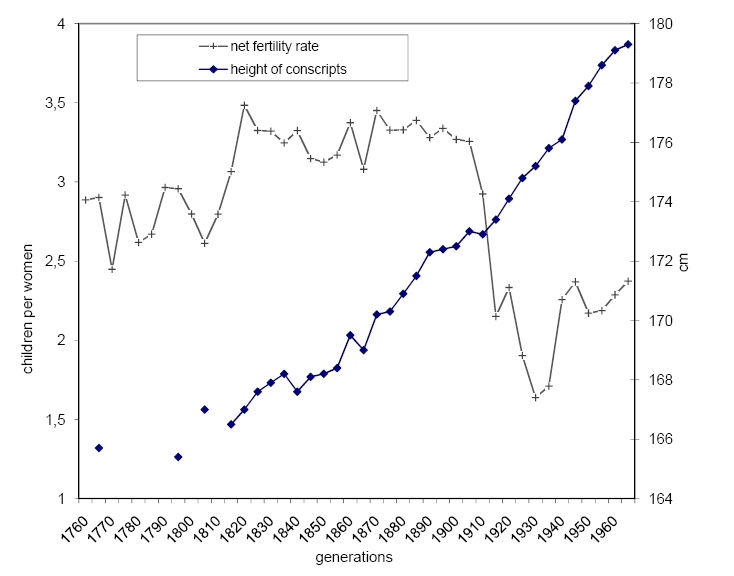
The epidemiology literature stresses that life expectancy depends greatly on physical development during childhood. Both better nutrition and lower exposure to infections leads to increased body height and a longer life. We propose a theory of the demographic transition based on this fact. The novel mechanism of the model is that parents face a trade-off between the quantity of children they have and the amount they can afford to spend on childhood development of each of them. If the cost of health decreases, parents will increase their investment in their children’s longevity. The number of children will first increase in the Malthusian regime as a consequence of higher lifetime income. As longevity rises, fertility starts falling as a result of the tradeoff faced by parents between investing in their own human capital and spending time rearing children. |
|
Links:
The Child is Father of the Man - Implications for the Demographic Transition, The Economic Journal, 123, 236-261 [with O. Licandro].
teaser |
abstract |
article |
slides |
 appendix |
 blog |
 photo |
citation |
photo |
citation |
 Licandro
|
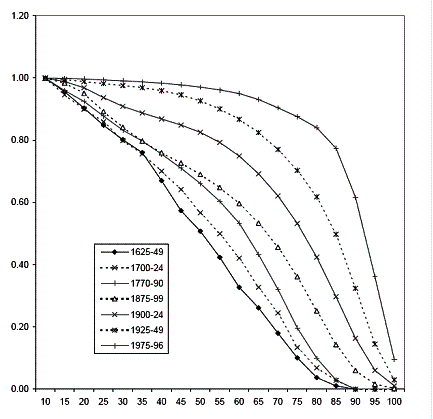
Longevity increased very much
over the last four centuries.
In Life expectancy and endogenous growth we show two results:
In, Vintage Human Capital, Demographic Trends and Endogenous Growth he above results are generalized for a realistic survival law of the form of the form 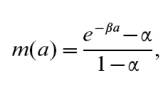
(a: age, m(a): survival probability, alpha and beta are two parameters) |
|
In Early Mortality Declines at the dawn of Modern Growth, Scandinavian Journal of Economics, increases in longevity can be responsible for a shift from a no-growth regime to a sustained growth regime. For this purpose, we use life tables prior to the industrial revolution (from Geneva and Venice), observe the improvements in longevity over the period 1500-1800, and use the model to assess quantitatively the effects on growth of these improvements.
Finally, a technical point: The dynamics of our models are described by differentials-difference equations. They account for discrete timing decisions in continuous time. More in Modeling vintage structures with DDEs: principles and applications.
Links:
Life expectancy and endogenous growth, Economics Letters, 65, 255-263, 1999. [with O. Licandro]
teaser |
abstract |
article |
slides |
citation |
Licandro
Vintage human capital, demographic trends and endogenous growth, Journal of Economic Theory, 104, 340-375, 2002 [with R. Boucekkine and O. Licandro]
teaser |
abstract |
article |
slides |
citation |
Boucekkine |
Licandro
Early mortality declines at the dawn of modern growth, Scandinavian Journal of Economics, 105, 401-418,2003 [with R. Boucekkine and O. Licandro].
teaser |
abstract |
article |
slides |
 data |
citation |
Boucekkine |
Licandro
data |
citation |
Boucekkine |
Licandro
Modelling vintage structures with DDEs: principles and applications, Mathematical Population Studies, 11, 151-179, 2004 [with R. Boucekkine and O. Licandro].
teaser |
abstract |
article |
citation |
Boucekkine |
Licandro
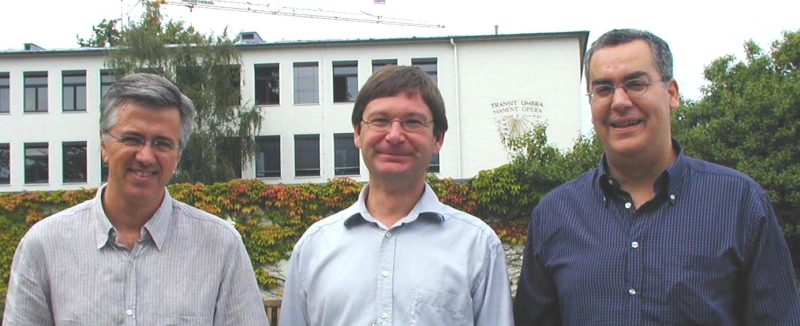
The co-authors (at Iza Bonn, 2006)
In two subsequent researches, we develop the approach further by introducing an additional mechanism through which higher population density may trigger the transition from stagnation to growth. In Early literacy achievements, population density and the transition to modern growth we provide micro-foundations according to which higher population density enables the set-up costs of additional schools to be covered, opening the possibility to reach higher educational levels. We also calibrate and simulate the model on English data 1540-1860. (see the section on History).
A reduced form version of the same mechanism is applied on Swedish data in Swedish Economic Growth and Education Since 1800, where we make use of original education data. We conclude there that It concludes that changes in longevity may account for as much as 20% of the observed rise in education over the period from 1800-2000 via a horizon effect, but have little impact on income growth over the period. On the contrary, changes in population density and composition are central, mainly thanks to their effect on productivity. Most income growth over this period would not have materialized if demographic variables had stayed constant since 1800.
Links:
Early literacy achievements, population density and the transition to modern growth, Journal of the European Economic Association, 5, 183-226, 2007 [with R. Boucekkine and D. Peeters].
teaser |
abstract |
article |
slides |
citation |
Boucekkine |
Peeters
Disentangling the Demographic Determinants of the English Take-off: 1530-1860, Population and Development Review Supplement, Population Aging, Human Capital Accumulation, and Productivity Growth, Alexia Prskawetz, David E. Bloom, and Wolfgang Lutz (eds.), 126-148, 2008 [with R. Boucekkine and D. Peeters].
article |
citation |
Boucekkine |
Peeters
Swedish Economic Growth and Education Since 1800, Canadian Journal of Economics, 41, 166-185, 2008 [with T. Lindh and B. Malmberg]
teaser |
abstract |
article |
slides |
data |
citation |
Lindh |
Malmberg