Bad or good institutions are key to explain why some countries managed to emerge from stagnation while some others still struggle to develop. This is at least the belief of International Institutions such as the World Bank at the beginning of the 21st century. We have looked at several types of institutions and at their relation with growth: Politics and the Structure of Education Funding [with Doepke], Institutions Promoting Gender Equality [with Vander Donckt], Failing Legal and Political Institutions [with Delavallade], Imperfect Financial Markets [with Azariadis, Lubrano and Michel], and Marriage Institutions [with Mariani].
In the centuries leading up to the industrial revolution, Western Europe gradually pulled ahead of other world regions in terms of technological creativity, population growth, and income per capita. We argue that superior institutions for the creation and dissemination of productive knowledge help explain the European advantage. We build a model of technological progress in a pre-industrial economy that emphasizes the person-to-person transmission of tacit knowledge. The young learn as apprentices from the old. Institutions such as the family, the clan, the guild, and the market organize who learns from whom. We argue that medieval European institutions such as guilds and specific features such as journeymanship can explain the rise of Europe relative to regions that relied on the transmission of knowledge within extended families or clans.
Links:
Clans, Guilds, and Markets: Apprenticeship Institutions and Growth in the Pre-Industrial Economy, Quarterly Journal of Economics, 133, 1-70, 2018 [with M. Doepke and J. Mokyr]
 teaser |
 abstract |
 article |
 data |
 slides |
 blog |
 citation |
 Doepke |
Mokyr
Doepke |
Mokyr
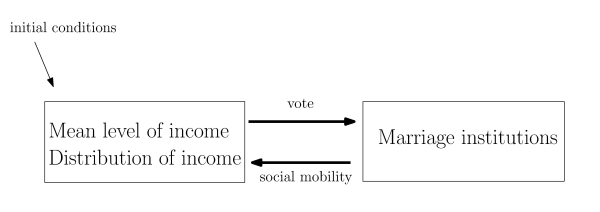
We consider an economy populated by males and females, both rich and poor. The society has to choose one of the following marriage institutions: polygyny, strict monogamy, and serial monogamy (divorce and remarriage).
|
At each date, one of these institutions arise as a political equilibrium. Marriage institutions are important for income distribution in the next period. Hence the model studies how institutions and income inequality change together over time. For given initial conditions, the model is able to predicts a change from polygyny to strict monogamy, followed later on by a move towards serial monogamy. |
|
we show that a rise in the share of rich males can explain a change of regime from polygyny to monogamy. This shift arises because, when the number of rich males is high enough, poor females have a chance to form a monogamic relationship with one of them, and stop supporting polygyny. The introduction of serial monogamy follows from a enrichment of the society, either through a further rise in either the share of rich males, or through an increase in the proportion of rich females.
|
Some specific conclusions are: First, unequal distribution of political power is not a necessary condition to have a transition from polygamy to monogamy and to serial monogamy. Second, polygamy could emerge as an political equilibrium in a democracy. Third, provided that the poor are a majority, monogamy arises as an intermediate regime and makes the transition towards serial monogamy faster. Finally, we provide the first political economic model of the introduction of divorce laws. |
|
Links:
From Polygyny to Serial Monogamy: a Unified Theory of Marriage Institutions, Review of Economic Studies, 82, 565-607 [with F. Mariani]
teaser |
abstract |
article |
 appendix |
slides |
blog |
appendix |
slides |
blog |
 wikipedia |
citation |
Mariani
wikipedia |
citation |
Mariani

|
Discernibly is gender equality a multi-dimensional concept that encompasses women's access to economic resources, women's access to health programs, women's legal rights and civil liberties and so forth. In this paper, we want to formally clarify the role of various dimensions to gender inequality in fostering the transition toward faster growth. Acknowledging the enhancing effect of a reduced population growth in the shift from economic stagnation to sustained growth, we especially want to examine the pathways by which increases in gender equality may affect fertility. We do so by means of a household bargaining model in which we explicitly distinguish between the following gender-based gaps: the survival gap, the wage gap, the social and institutional gap and the educational gap. |
Links:
Would Empowering Women Initiate the Demographic Transition in Least-Developed Countries ?, Journal of Human Capital, 4, 85-129 [with M. Vander Donckt].
teaser |
abstract |
article |
citation
Public education can help to promote growth by reducing differential fertility. See the page on differential fertility.
Links:
Public versus private education when differential fertility matters, Journal of Development Economics, 73, 607-629, 2004 [with M. Doepke]
teaser |
abstract |
article |
citation |
Doepke

[Matthias Doepke] |
How is the quality of public education affected by the presence of private schools for the rich? Theory and evidence suggest that the link crucially depends on the structure of the political system. A large private education sector can benefit public schools in a broad-based democracy where politicians are responsive to the needs of families using public schools, but leads to disastrous outcomes in a society that is politically dominated by the rich. This question was treated in the article below (among other things, see page on fertility) and was popularized by an article in Vox. |
Links:
To Segregate or to Integrate: Education Politics and Democracy, Review of Economic Studies, 76, 597-628, 2009 [with M. Doepke].
teaser |
abstract |
article |
slides |
data |
blog |
citation |
Doepke

[Clara Delavallade] |
In two papers, we bridge the gap between the standard theory of growth and the mostly static theory of corruption. Part of public investment can be diverted from its purpose by corrupted individuals. Voters determine the level of public investment subject to an incentive constraint equalizing the returns from productive and corruption activities. We concentrate on two exogenous institutional parameters: the``technology of corruption'' is the easiness with which rent-seekers can capture part of public spending. The ``concentration of political power'' is the extent to which rent-seekers have more political influence than other people. The first paper concentrates on the effects of the two institutional parameters on income growth and equilibrium corruption. In the second paper the focus is on how failing institutions distort the allocation of resources between different types of public investment. |
Links:
Democracy, Rule of Law, Corruption Incentives and Growth, Journal of Public Economic Theory, 13, 155-187 [with C. Delavallade].
teaser |
abstract |
article |
citation |
Delavallade
Growth, Public Investment and Corruption with Failing Institutions, Economics of Governance, 10, 187-219 [with C. Delavallade].
teaser |
abstract |
article |
slides |
data |
citation |
Delavallade
In the following paper, the idea that corruption is not exogenous but, instead, an equilibrium phenomenon has implications for aid policy.
Aid is allocated to countries with better institutions, but also to poorer countries, i.e. those with lower productivity. In theory, an improvement in the quality of institutions induces a lower level of corruption and a higher level of aid reception, implying that the correlation between aid and corruption should be negative. However this can be counterbalanced by a productivity effect: lower levels of productivity are associated with higher levels of both corruption and optimal aid, leading to a positive correlation between aid and corruption. Therefore, if developing countries are more heterogenous in terms of productivity than in terms of institutional quality, the effect of the productivity component outweighs and the level of aid received is positively correlated to the level of corruption. Since indeed most corrupt countries are also the poorest it is optimal to provide them with more aid.
Why Corrupt Governments May Receive More Foreign Aid, Oxford Economic Papers, 66, 51-66 [with C. Delavallade].
teaser |
abstract |
article |
appendix |
citation |
Delavallade
|
We explore the consequences of liberalized credit markets for growth and inequality. Relatively modest improvements in extending credit to the ablest households appear to have large economic consequences: upfront costs (slower initial growth, higher income inequality) followed by delayed benefits (faster long-run growth). Financial reform also lowers lifecycle utility for a substantial majority of currently active households. Premature liberalization in the least developed countries (low TFP or capital intensity) may redirect economic growth towards a poverty trap. [Costas in his L.A. office] |

|
Links:
Financial Institutional Reform, Growth, and Equality, Institutions, Development, and Economic Growth, T. Eicher and C. Garcia Peñalosa eds, MIT Press, 33-64, 2006 [with C. Azariadis].
teaser |
abstract |
article |
slides |
citation |
Azariadis
|
In the following paper, we study a simple theoretical model where endogenous borrowing limits arise as the outcome of individual rationality constraint. We show that maximum growth can arise in an equilibrium with binding borrowing constraints, perhaps explaining the good performance of Asian countries despite imperfect credit markets. Philippe Michel passed away on July 22, 2004. His death is a great loss for his friends and for the overlapping generations and optimal control community. |

|
Links:
Education and growth with endogenous debt constraints, Economic Theory, 33, 509-530, 2007 [with P. Michel].
teaser |
abstract |
article |
slides |
citation |
Michel
|
In the following article with Michel Lubrano (picture on the right), we use the model developed with Costas Azariadis to analyze the tradeoff between growth and equality in a variety of context. Here, we look at the effect of the ELIE scheme, which was developed by Kolm. It taxes labour capacities instead of labour income in order to circumvent the distortionary effect of taxation on labour supply. Still we show it has a distortionary effect on the education choice. ELIE is successful in reducing inequalities and poverty. A drop in the Gini coefficient by 0.10 goes with a reduction in the annual growth rate of 0.33\%. In an economy with an imperfect credit market where individuals cannot borrow to educate, the tradeoff between growth and equality is not overturned but is less severe. |

|
Links:
The Tradeoff Between Growth and Redistribution: ELIE in an Overlapping Generations Model, in Macrojustice : A pluridisciplinary evaluation of Kolm's theory, C. Gamel and M. Lubrano eds, Springer, 307-339 [with M. Lubrano]
teaser |
abstract |
article |
blog |
citation |
Lubrano