Welcome to Vincent Yzerbyt's homepage!!
Bienvenue sur la page web de Vincent Yzerbyt!!
Full CV / CV complet ----- List
of Publications / Liste
de Publications
Pour
lire notre proposition de refinancement de l’enseignement
supérieur
Web companion page of the
JPSP paper by Muller, Judd, & Yzerbyt (2005)
Web companion page of the
Reis & Judd chapter by Judd, Yzerbyt, & Muller (2014)

Vincent Yzerbyt was born April 15, 1961 in Kortrijk, Belgium.
A full professor of psychology and statistics at the Université catholique de Louvain (UCLouvain),
Belgium, he is the head of the Louvain Social Psychology Laboratory.
His research is
mainly concerned with social cognition,
impression formation, and intergroup relations, and more
specifically with the formation and preservation of stereotypes along with their impact on issues of gender and
cultural diversity. After his
early work on the Black Sheep effect
and the Ingroup Overexclusion
effect, he mainly developed an interest in stereotyping and more
specifically in the formation and preservation of stereotypes as well as their
suppression. The basic idea is that people rely on stereotypes not only for cognitive reasons (they face limited
resources) but also for motivational
reasons (their stereotypes serve their own as well as their group’s
image) and social reasons (they
believe stereotypes are shared by their group members). He then turned to group perception by examining aspects
of homogeneity, entitativity, and
essentialism, showing the role of entitativity in people’s tendency
to account for group behaviour by referring to inherent characteristics. He
also initiated a program of research on social
emotions in which he investigated whether, how, and why people experience
emotions not because of events that occur to them personally, but because of
events that affect members of groups to which they belong. More recently, he turned his attention to the fundamental dimensions of social perception,
i.e., Competence and Warmth. With his Dimensional Compensation Model,
Vincent Yzerbyt proposed that people who are perceived to be competent also
tend to be perceived as not so warm and conversely. He continues to investigate the way social structural
factors that characterize relations between social groups such as power,
resources, and status on the one hand and beliefs, values, and goals on the
other shape people’s evaluation of themselves and others in terms of competence (comprising ability and
assertiveness) and warmth (comprising friendliness and
morality). In 2018, he and four other prominent scholars embarked on an adversarial collaboration whereby
researchers join forces to evaluate competing models of social evaluation, an
initiative that opened the path to a novel,
respectful, and indeed productive way to advance knowledge. When the COVID-19
pandemic broke out, he became involved as one of the main PI’s
in the Motivation Barometer, a
Belgian interuniversity initiative that lasted for two years and surveyed some
500,000 citizens to monitor a large number of social
and psychological variables related to adherence to sanitary measures and
vaccination. Clearly, the fundamental dimensions of competence and warmth are
at the very heart of trust, a key
element in people’s reaction to vaccination. Moreover, his work on social
emotions and social identity bears direct relevance for the management of the pandemic not only
because emotions (fear, anxiety,
resentment, and anger) are at the core of people’s reactions about the
COVID but also because the ‘subjective’ definition of the social landscape is a crucial aspect of
an efficient communication
by experts and authorities. Another line of work to which he contributed is statistics and methods. Vincent Yzerbyt
helped delineate
conditions for the use of ANCOVA in personality and social research as well as a series of key issues pertaining to tests
of moderation and mediation models
in both survey and experimental data.
Vincent Yzerbyt is the author of more than 250 peer-reviewed
publications, some 50 chapters and a dozen monographs,
edited books, and textbooks mostly in English and in French. His most recent
books deal with The Psychologies of
Gender (2020) and The Psychology of
Vaccination (2023). As of July 2023, his Google Scholar H amounts to 76
with 28452 citations. He has supervised 25 Ph.Ds. (with an additional 6 under
way), 11 post-docs, and took part in 5 HDR committees in France. He was a visiting professor at the
Université libre de Bruxelles and at the University of Amsterdam, of
Tunis, and of Clermont-Ferrand and a visiting
scholar at the University of Colorado, Boulder and Princeton
University. A Francqui chair recipient of the
Vrije Universiteit Brussel in 2006, he received a Career Trajectory Award by the American Society of Experimental
Psychology (2007) as well as the Kurt
Lewin Award (2008) followed by a Jean-Paul
Codol Award (2017) from the European Association
of Social Psychology. He has been the founding chief editor of the Social
Psychological and Personality Science (2009-2013) and associate editor of
several top-notch outlets in his field (Journal of Personality and Social
Psychology, British Journal of Social Psychology, and Personality and Social
Psychology Bulletin). He is the current chief editor of the International
Review of Social Psychology (2023-2027). A former President of the European Association of Social Psychology
(2002-2005) and Chair of the European Social Cognition Network (2009-2014), he
also served as the Vice-Rector of
Research of UCLouvain (2009-2014).
Pour une approche à la fois moderne et
aisée en statistique en sciences humaines et sociales, plongez-vous
dans…
L’analyse des données : Une approche par comparaison de
modèles.
Correll, J., Folberg, A., Judd, C. M., McClelland, G. H., Ryan, C. R.,
Muller, D., Rougier, M., & Yzerbyt, V. (2026).
De Boeck, Bruxelles.
Pour vous rendre sur le
site De Boeck, cliquez
ici
Pour vous rendre sur le site Amazon.fr, cliquez
ici
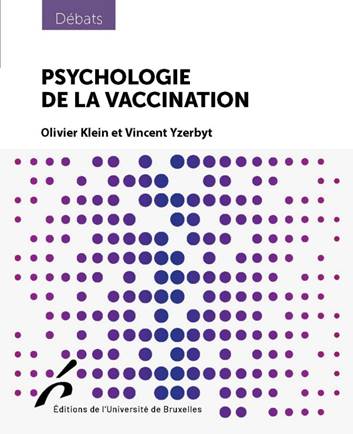
De la
simple passivité à un refus délibéré,
parfois claironné publiquement, on trouve une vaste gamme d'attitudes,
regroupées sous le vocable « d’hésitation
vaccinale ». Cet ouvrage s’intéresse aux personnes qui
adoptent cette attitude.
La psychologie de la
vaccination
Klein, O. &
Yzerbyt, V. (2023).
Éditions de
l'Université de Bruxelles, Bruxelles.
Pour vous rendre sur le
site des Editions de l’UB, cliquez ici Pour vous rendre sur
le site Amazon.fr, cliquez
ici
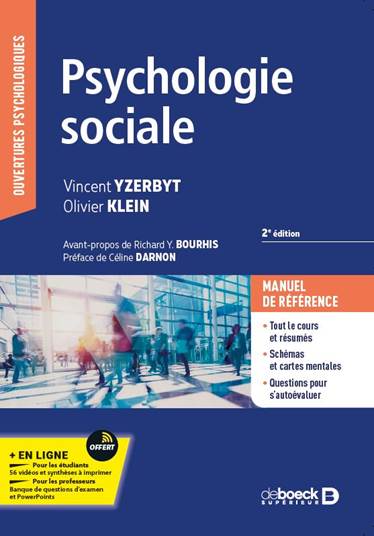
Véritable panorama de la psychologie sociale et de
ses approches européennes et anglo-saxonnes. Tout en couleurs, avec un
appareil pédagogique riche.
Psychologie sociale (2 édition)
Yzerbyt, V. &
Klein, O. (2023).
De Boeck, Louvain-la-Neuve.

Pour vous rendre sur le
site De Boeck, cliquez
ici
Pour vous rendre sur le site Amazon.fr, cliquez
ici
Une première en langue française !
Rassemblées en un seul ouvrage, les approches du genre dans les
différentes sous-disciplines de la psychologie
Les psychologies du
genre : Regards
croisés sur le développement, l'éducation, la santé
mentale et la société
Yzerbyt, V., Roskam,
I. & Casini, A. (2021).
Mardaga, Bruxelles.

Pour vous rendre sur le
site Mardaga, cliquez
ici
Pour vous rendre sur le site Amazon.fr, cliquez
ici
Pour une présentation complète et succincte
des travaux sur les relations intergroupes, stéréotypes et autres
préjugés…
Les relations intergroupes
Yzerbyt, V. &
Demoulin, S. (2019).
Presses Universitaires de Grenoble, Grenoble.

Pour vous rendre sur le
site PUG, cliquez
ici
Pour vous rendre sur le site Amazon.fr, cliquez
ici
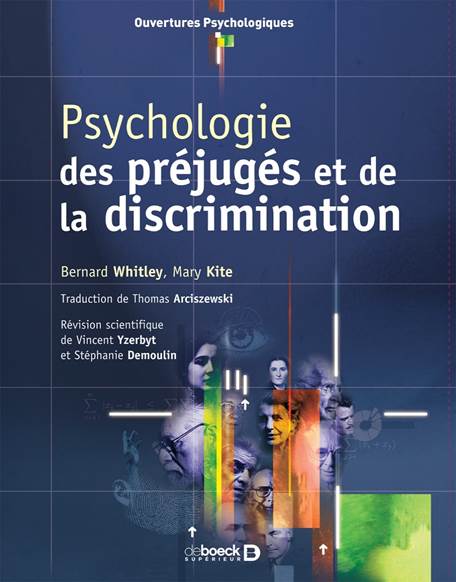
Pour un tour d’horizon complet en matière de
stéréotypes et autres a priori sur tout un chacun,
précipitez-vous sur …
Psychologie des préjugés et de la discrimination.
Whitley, B &
Kite, M (2013)
(traduit
par T. Arciszewski sous la supervision scientifique de V. Yzerbyt et S.
Demoulin)
De Boeck, Bruxelles.
|
|
|
|
|
|
|
|
|
|
|
|
|
|
Professional
Address
- Université catholique de Louvain
- Faculté de Psychologie et des Sciences de
l'Education
- Unité de Psychologie Sociale et des
Organisations
- Place du Cardinal Mercier, 10
- B-1348 Louvain-la-Neuve
- Belgique
- Tel: 32 (0) 10 47 43 76
- Fax: 32 (0) 10 47 37 74
- Email address: vincent.yzerbyt at
uclouvain.be
- Google
Scholar Citations
- University Publications Repository /
Dépôt Institutionnel Universitaire
- Web sites: http://perso.uclouvain.be/vincent.yzerbyt/ or http://yzerbyt.socialpsychology.org/
Scientific
Awards
- 2023 Honorary doctorate from the University of
Basel (Switzerland)
- 2022 five-yearly Tobie Jonckheere Award (Psychological
and educational Sciences) of the Royal Academy of Belgium for the
monograph ‘Les Psychologies du Genre’ (Mardaga,
2020)
- 2017, Jean-Paul
Codol Award de la European Association of Experimental Social Psychology (EASP)
- 2011, Fellow of the Society of Personality and
Social Psychology (USA)
- 2008, Kurt Lewin Award of the European
Association of Social Psychology (EASP)
- 2008, Fellow of the Association for Psychological
Science (USA)
- 2007, Career Trajectory Award of the Society of
Experimental Social Psychology (USA)
- 2005-2006, Francqui
Chair of the Vrije Universiteit Brussel, Francqui
Foundation
- 1996, Membership of Society of Experimental
Social Psychology (USA)
- 1994, Five-yearly National Award for Early Career
in Psychology, Belgian University
Foundation
- 1984, Fulbright Fellow - Commission for
Educational Exchange - USIA grant IA-AEGH-G6192688
Research
Interests
- Stereotyping and intergroup
relations
- Emotions in the context of
intergroup relations: collective, intergroup, and group-based emotions
- Essentialism and
entitativity in group perception
- Stereotype change and
stereotype suppression
- Black Sheep Effect and
Ingroup Overexclusion
- Attribution
- Fundamental attribution
error and dispositional suppression
- Pragmatic aspects of the overattribution bias
- Social attribution
- Data Analysis
- Analysis of Covariance,
ANCOVA
- Mediation, Moderated
Mediation, Mediated Moderation
Links
|
|
|
|
Links to Various Societies… |
and their Publications |
|
|
|
|
|
|
|
Consortium of ARP / EASP / SESP / SPSP |
|
|
|
|