
Modern low-latency applications—such as online gaming, remote control systems, and real-time file access—are increasingly sensitive to packet loss and delay. Traditional transport protocols like TCP and QUIC mitigate packet loss through retransmissions, but this leads to additional round-trip delays that can significantly impact tail latency. Our paper co-authored with Louis Navarre and François Michel, “A High-Speed Robust Tunnel using Forward Erasure Correction in Segment Routing” has been published at ICNP’24 introduces HIRT, a system that applies Forward Erasure Correction (FEC) at the network layer to proactively recover from packet losses without relying on retransmissions.

HIRT is built on IPv6 Segment Routing (SRv6) and leverages Random Linear Coding (RLC) to inject repair packets into the network path. These packets can be used by the receiver to reconstruct lost data without waiting for retransmissions, thereby reducing tail latency. Unlike traditional FEC schemes embedded at the transport layer, HIRT operates transparently at the network layer, requiring no changes to end-host protocols. This allows network operators to deploy it as a service that selectively protects latency-sensitive traffic across tunnels, including encrypted VPN flows.
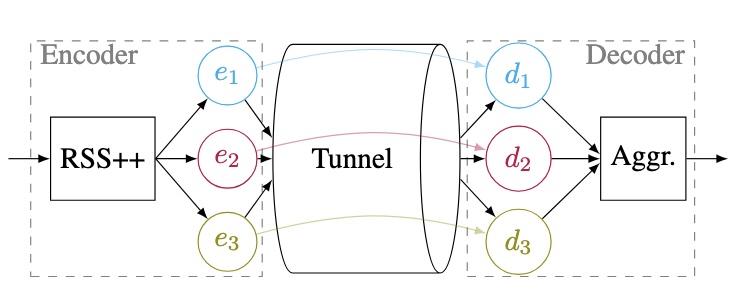
We implemented HIRT using FastClick, achieving line-rate processing beyond 60 Gbps on commodity servers, even under >3% packet loss. The system adapts redundancy dynamically based on feedback from the receiver and employs several optimizations, including DPDK kernel bypass, SIMD acceleration, and a multithreaded architecture. Each processing stream is handled independently, avoiding bottlenecks and enabling scalability across cores. HIRT also detects overload conditions and throttles encoding/decoding to avoid contributing to packet drops under high CPU load.
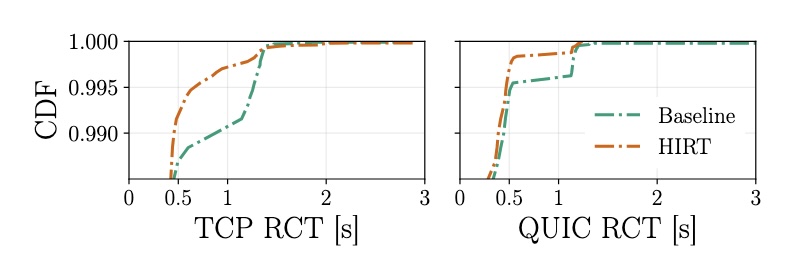
Evaluations over the Starlink LEO satellite network—which shows bursty, non-congestion-induced losses—demonstrate HIRT’s practical benefits. It reduced HTTP tail latency by up to 2× and improved completion times for 1 MB file transfers by 20% compared to loss-based recovery alone. Similarly, latency for NFS read/write operations improved by up to 14%. Compared with prior FEC solutions like Maelstrom, HIRT achieves better recovery at lower overhead, thanks to its adaptive approach and more powerful coding strategy. Its network-layer placement also makes it easier to deploy incrementally without disrupting application stacks.