
Accepted paper to be presented at CoNEXT’25 ; Nikita Tyunyayev (UCLouvain), Clément Delzotti (UCLouvain), Haggai Eran (NVIDIA) and Tom Barbette (UCLouvain)
In recent years, bypassing the Linux kernel networking stack has become a common strategy to accelerate packet processing. Techniques like DPDK eliminate kernel overhead, enabling network functions to run at much higher speeds. However, these solutions do not fundamentally change how packets are exchanged between the Network Interface Controller (NIC) and the CPU.
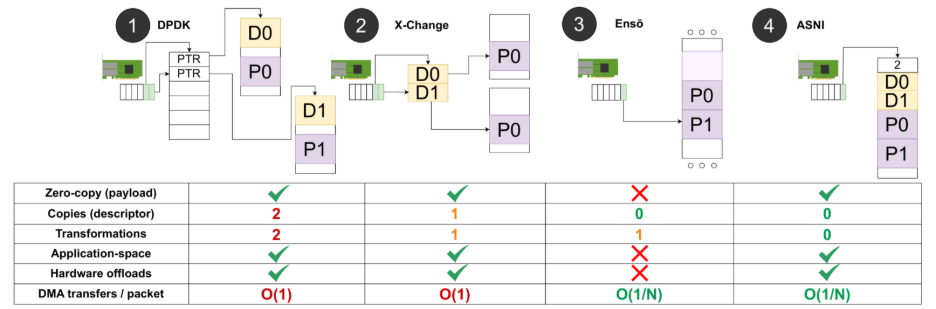
At the core of this communication are descriptors: NIC-specific metadata structures that reference memory buffers and encapsulate information such as VLAN tags, flow IDs, tunnel IDs, timestamps, and L3/L4 protocol information. Because descriptor formats vary across NIC vendors, both the Linux networking stack and user-space drivers like DPDK must translate these proprietary formats into a generic representation. This translation consumes substantial CPU resources, even though most of the metadata is typically unused by applications. Additionally, applications often perform further metadata transformations themselves. X-Change addresses some of those inefficiencies by proposing a unified model that merges driver-level and application-level metadata.
Ensō introduced a streaming interface that eliminates pointer indirection by delivering packets as a continuous array. While this improves performance through better memory locality and reduced overhead, it introduces challenges when packets need to be processed out of order, requiring costly copying operations.
Introducing ASNI: Application-Specific Network Interface
In our CoNEXT 2025 paper, we present ASNI, a new approach that builds upon, rather than replaces, the traditional packetized interface. ASNI delivers packets in large, contiguous buffers, each capable of holding multiple packets and their metadata, organized in a format tailored to the specific needs of the application. By offloading the majority of the driver datapath from the CPU to the NIC, ASNI significantly reduces CPU overhead.
Our design brings three key benefits
- Improved PCIe efficiency through better buffer utilization
- Higher packet and metadata locality, reducing cache misses
- Application-specific metadata layouts and content, avoiding unnecessary transformations

In NFV scenarios, ASNI outperforms DPDK, the dominant kernel-bypass solution, by serving 2.2× more traffic, demonstrating its effectiveness in high-throughput, low-latency environments.